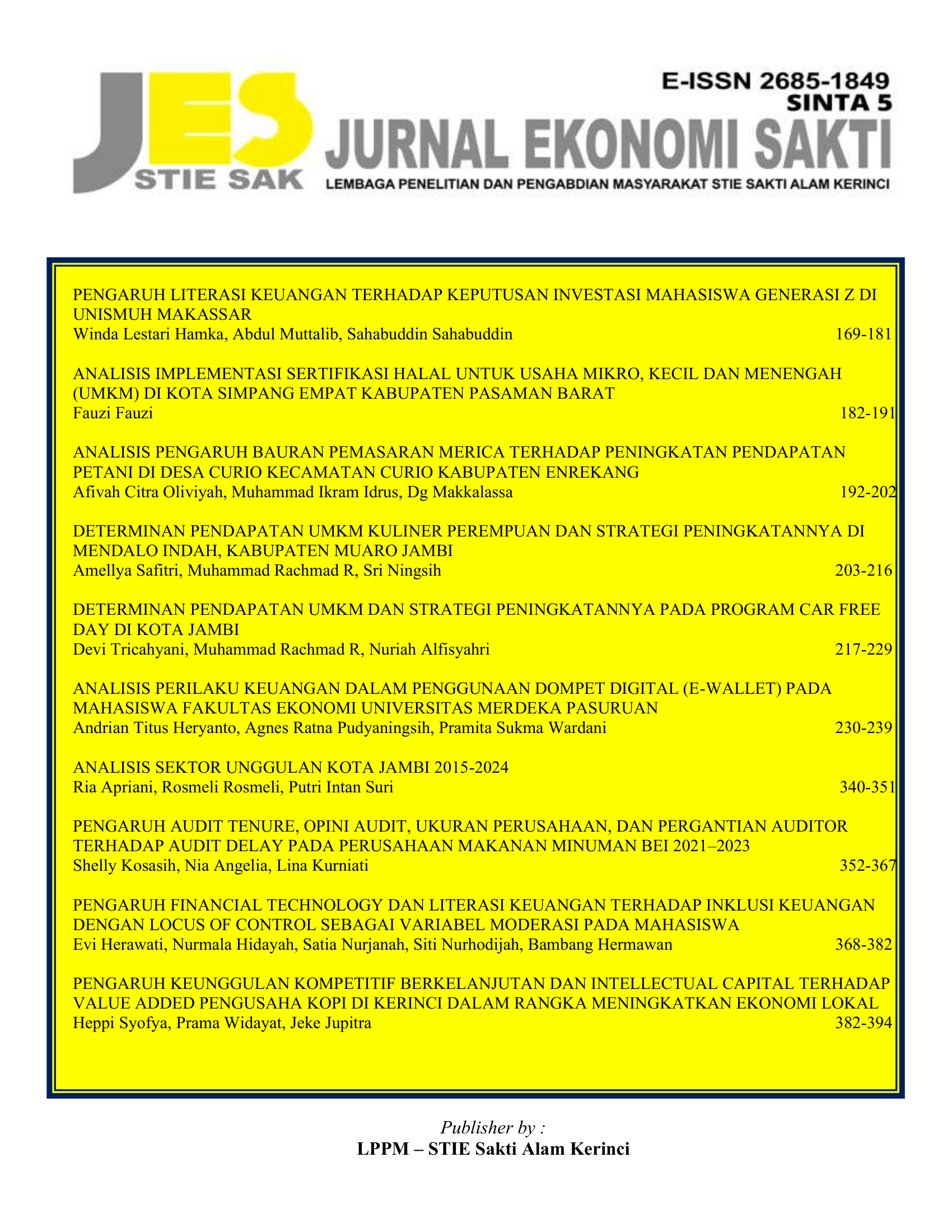
PENGARUH KEUNGGULAN KOMPETITIF BERKELANJUTAN DAN INTELLECTUAL CAPITAL TERHADAP VALUE ADDED PENGUSAHA KOPI DI KERINCI DALAM RANGKA MENINGKATKAN EKONOMI LOKAL
DOI:
https://doi.org/10.36272/jes.v15i2.518Keywords:
Sustainable Competitive Advantage, Intellectual Capital, Value Added, Coffee Industry, Local Economy, KerinciAbstract
This study examines the impact of sustainable competitive advantage and intellectual capital on the added value of coffee entrepreneurs in Kerinci, with the aim of improving the local economy. Through quantitative analysis, survey data were collected from a sample of coffee entrepreneurs and analyzed using statistical techniques such as descriptive analysis and measurement model assessment with SEM-SmartPLS-4 software. The findings reveal a positive and significant relationship between sustainable competitive advantage and added value, highlighting the importance of unique resources and strategies in generating higher value. In addition, this study finds a positive and significant relationship between intellectual capital and added value, emphasizing the role of knowledge, skills, and relationships in achieving greater added value outcomes. The results of this study provide valuable insights for coffee entrepreneurs, policymakers, and industry stakeholders to encourage sustainable growth and economic development in the local coffee industry
Downloads
References
Ardhi, M. K., & Mulyo, J. H. (2021). How does entrepreneurial orientation affect the business performance of coffee shop MSMEs in Indonesia? E3S Web of Conferences, 306, 3011. DOI: https://doi.org/10.1051/e3sconf/202130603011
Arina, K. K., Sumanti, A. I., & Gradianto, G. (2022). The Government Support on Women Entrepreneurial Intention Affected by Layoffs in Tourism Industry. DOI: https://doi.org/10.24922/eot.v9i1.80576
Arsawan, I. W. E., Koval, V., Rajiani, I., Rustiarini, N. W., Supartha, W. G., & Suryantini, N. P. S. (2020). Leveraging knowledge sharing and innovation culture into SMEs sustainable competitive advantage. International Journal of Productivity and Performance Management. DOI: https://doi.org/10.1108/IJPPM-04-2020-0192
Barney, J. (1991). Firm resources and sustained competitive advantage. Journal of Management, 17(1), 99–120. DOI: https://doi.org/10.1177/014920639101700108
Barrutia, J. M., & Echebarria, C. (2022). Harnessing social interaction and intellectual capital in intergovernmental networks. Journal of Intellectual Capital, 23(3), 639–665. DOI: https://doi.org/10.1108/JIC-09-2019-0226
Bimantara, K. A., Alauddin, S. F. N., Amalia, N., Widialip, N. F., Citrasari, N., & Hariyanto, S. (2021). Circular economy of bio compost from coffee waste to support sustainable development goals in alleviating poverty in communities around the Sidoarjo coffee industry. IOP Conference Series: Earth and Environmental Science, 802(1), 12016. DOI: https://doi.org/10.1088/1755-1315/802/1/012016
Chin, W. W. (1998). The partial least squares approach to structural equation modeling. Modern Methods for Business Research, 295(2), 295–336.
Cohen, S., & Salavou, H. (2016). Intellectual Capital in Social Enterprises. Available at SSRN 3408654.
Creswell, J. W. (2013). Research Desain: Pendekatan Kualitatif, Kualitatif, Dan Mixed (Edisi Keti). Yogyakarta.
Dewi, N. L. M. I. M., Putra, I. P. I. P., & Astama, I. K. (2022). The Study of Added Value Analysis of Coffee Processing in Indonesia. Agribusiness Journal, 5(2), 71–78. DOI: https://doi.org/10.31327/aj.v5i2.1839
Diugwu, I. (2011). Knowledge acquisition and sharing: a sustainable source of competitive advantage in supply chains. Proceedings of the International Conference on Intellectual Capital, Knowledge Management & Organizational Learning, 157–163.
Febrian, A. F., & Maulina, E. (2018). The influence of social capital and financial capability on sustainable competitive advantage through entrepreneurial orientation : Empirical evidence from Small and Medium Industries in Indonesia using PLS-SEM. 5(12), 218–232. DOI: https://doi.org/10.14738/assrj.512.5720
Fernaldi, R. (2016). Perumusan Added Value Dalam Konsep Bisnis Coffeein Melalui Pendekatan Blue Ocean Strategy. Jurnal Performa: Jurnal Manajemen Dan Start-up Bisnis, 1(1), 105–111. DOI: https://doi.org/10.37715/jp.v1i1.103
Fridell, G. (2007). Fair trade coffee: The prospects and pitfalls of market-driven social justice (Vol. 28). University of Toronto Press. DOI: https://doi.org/10.3138/9781442684331
Ghozali, I. (2014). SEM Metode Alternatif dengan menggunakan Partial Least Squares (PLS). Semarang: Badan Penerbit Universitas Diponegoro.
Hair, J. F., Ringle, C. M., & Sarstedt, M. (2017). A Primer on Partial Least Squares Structural Equation Modelling (PLS-SEM). 2e Edition. SAGE Publications.
Heppi Syofya, & Enang Dwisefianto. (2024). Analisis Faktor Penentu Ekspor Kopi di Indonesia. El-Mal: Jurnal Kajian Ekonomi & Bisnis Islam, 5(8), 4119 –. https://doi.org/10.47467/elmal.v5i8.4614 DOI: https://doi.org/10.47467/elmal.v5i8.4614
Hidayat, W., & Handoyo, D. W. (2022). Strategic Orientation, Innovation and Competitive Advantage of SMEs: A Case Study of Creative Industry in Central Java.
Huang, C.-C., & Huang, S.-M. (2020). External and internal capabilities and organizational performance: Does intellectual capital matter? Asia Pacific Management Review, 25(2), 111–120. DOI: https://doi.org/10.1016/j.apmrv.2019.12.001
Hussain, I., Mu, S., Mohiuddin, M., Danish, R. Q., & Sair, S. A. (2020). Effects of sustainable brand equity and marketing innovation on market performance in hospitality industry: Mediating effects of sustainable competitive advantage. Sustainability, 12(7), 2939. DOI: https://doi.org/10.3390/su12072939
Istanti, S., Chariri, A., & Juliarto, A. (2021). The role of intellectual capital as a mediation of relationship between audit committee and real earnings management. Accounting, 7(7), 1799–1804. DOI: https://doi.org/10.5267/j.ac.2021.4.008
Jarvis, C. B., MacKenzie, S. B., & Podsakoff, P. M. (2003). A critical review of construct indicators and measurement model misspecification in marketing and consumer research. Journal of Consumer Research, 30(2), 199–218. DOI: https://doi.org/10.1086/376806
Kaido, B., Takashino, N., & Fuyuki, K. (2021). Challenges of Arabica coffee marketing: A case study in Kerinci regency, Indonesia. Asian Journal of Agriculture and Rural Development, 11(1), 53. DOI: https://doi.org/10.18488/journal.ajard.2021.111.53.62
Khan, S. Z., Yang, Q., & Waheed, A. (2019). Investment in intangible resources and capabilities spurs sustainable competitive advantage and firm performance. Corporate Social Responsibility and Environmental Management, 26(2), 285–295. DOI: https://doi.org/10.1002/csr.1678
Liebig, T., Ribeyre, F., Laederach, P., Jassogne, L., Poehling, H.-M., Van Asten, P. J. A., & Avelino, J. (2016). Characterisation of microclimatic indicators in coffee production systems under varying biophysical contexts and its relation to fungal coffee diseases.
Liu, C.-H. (2017). The relationships among intellectual capital, social capital, and performance-The moderating role of business ties and environmental uncertainty. Tourism Management, 61, 553–561. DOI: https://doi.org/10.1016/j.tourman.2017.03.017
Meissner, F., & Komba, X. K. (2011). Balanced growth through local entrepreneurship: The Komba coffee project in southern Tanzania. In Balanced Growth: Finding Strategies for Sustainable Development (pp. 183–193). Springer. DOI: https://doi.org/10.1007/978-3-642-24653-1_12
Nirino, N., Ferraris, A., Miglietta, N., & Invernizzi, A. C. (2022). Intellectual capital: the missing link in the corporate social responsibility–financial performance relationship. Journal of Intellectual Capital, 23(2), 420–438. DOI: https://doi.org/10.1108/JIC-02-2020-0038
Ognjanović, J., & Slavković, M. (2022). Intellectual capital and financial performance of entrepreneurs in the hotel industry. Менаџмент у Хотелијерству и Туризму, 10(1), 25–40. DOI: https://doi.org/10.5937/menhottur2201025O
Osareh, F., Yazdanfar, S., & Ghasemi, A. (2013). The application of intellectual capital approach to promote a sustainable competitive advantage in the public libraries of Khuzestan Province. The Quarterly Journal of Iran Public Libraries Foundation ISSN, 1027, 7838.
Rahmah, D. M., Mardawati, E., Kastaman, R., Pujianto, T., & Pramulya, R. (2023). Coffee Pulp Biomass Utilization on Coffee Production and Its Impact on Energy Saving, CO2 Emission Reduction, and Economic Value Added to Promote Green Lean Practice in Agriculture Production. Agronomy, 13(3), 904. DOI: https://doi.org/10.3390/agronomy13030904
Rhiney, K., Guido, Z., Knudson, C., Avelino, J., Bacon, C. M., Leclerc, G., Aime, M. C., & Bebber, D. P. (2021). Epidemics and the future of coffee production. Proceedings of the National Academy of Sciences, 118(27), e2023212118. DOI: https://doi.org/10.1073/pnas.2023212118
Rosiana, N., Nurmalina, R., Winandi, R., & Rifin, A. (2018). Dynamics of Indonesian robusta coffee competition among major competitor countries. DOI: https://doi.org/10.21082/jtidp.v5n1.2018.p1-10
Siniak, N., & Lozanoska, D. K. (2019). A review of the application of the concept of economic and smart sustainable value added (SSVA) in industries performance evaluations. BRAIN. Broad Research in Artificial Intelligence and Neuroscience, 10(1), 129–136. DOI: https://doi.org/10.70594/brain/v10.i1/13
Siti Nurjanah, H. S. (2022). DEVELOPING AUGMENTED REALITY APPLICATION ON COFFEE SHOP. Journal of Southwest Jiaotong University, 57(1). DOI: https://doi.org/10.35741/issn.0258-2724.57.1.29
Syakir, M., & Surmaini, E. (2017). Perubahan iklim dalam konteks sistem produksi dan pengembangan kopi di Indonesia.
Tenenhaus, M., Vinzi, V. E., Chatelin, Y.-M., & Lauro, C. (2005). PLS path modeling. Computational Statistics & Data Analysis, 48(1), 159–205. DOI: https://doi.org/10.1016/j.csda.2004.03.005
Tin Ming Kaw, M. (2020). Intellectual Capital, Value Creation and Firm Performance in Singapore. Cardiff Metropolitan University.
Van der Merwe, K., & Maree, T. (2016). The behavioural intentions of specialty coffee consumers in South Africa. International Journal of Consumer Studies, 40(4), 501–508. DOI: https://doi.org/10.1111/ijcs.12275
Willer, H., & Garibay, S. V. (2014). Data on estimated area harvested, production, production sold as organic for organic bananas, cocoa, coffee, palm oil, soybeans, sugarcane, tea. In The State of Sustainability Initiatives Review 2014. Standards and the Green Economy. International Institute for Sustainable Development (IISD) and International ….
Yudha, A. P. (2021). INCREASING QUALITY OF PRODUCTION AND MARKET ACCESS FOR COFFEE FARMING GROUPS THROUGH BEHAVIOR CHANGES AND HARVEST MANAGEMENT. Qardhul Hasan: Media Pengabdian Kepada Masyarakat, 7(2), 113–120.
Zamora Matute, C. E. (2012). Antecedents of dynamic capabilities: the role of entrepreneurial orientation and intellectual capital. DOI: https://doi.org/10.5465/AMBPP.2012.16564abstract
Downloads
Published
Issue
Section
License
Copyright (c) 2026 JURNAL EKONOMI SAKTI (JES)

This work is licensed under a Creative Commons Attribution 4.0 International License.







1.png)